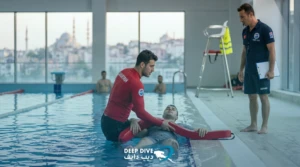
Swimming for Infants, Recently, there has been a growing trend of teaching swimming to infants and newborns, as it has been observed that newborns and infants master swimming skills that adults sometimes find difficult to master, especially since swimming is an innate skill acquired at birth.
This is because infants and newborns are naturally able to swim easily; they are biologically accustomed to swimming while in their mother’s womb, and their limbs are well-suited for moving easily in water.
In today’s article, we will discuss one of the most effective ways to develop and nurture swimming skills in infants under the supervision of specialized instructors at our Deep Dive center.

The Benefits of Swimming for Infants
Teaching infants and newborns to swim is one of the most important skills a child can develop, along with walking, crawling, and others.
- Swimming helps improve heart and circulatory health in infants.
- It strengthens lung function, helping the lungs hold more air, which in turn supports faster brain development.
- It improves and strengthens muscle function; swimming strengthens a child’s muscles. By 5 or 6 months of age, a child typically begins to walk, and with swimming training, a child’s muscles develop, allowing them to walk earlier than peers of the same age who do not swim.
- Swim instructors note that while swimming, a child moves their arms while kicking their legs, which means their brain registers the sensation of touching the water as well as its resistance, thereby enhancing its ability to stimulate brain development.
- Improving the child’s endurance: Children who swim make progress in physical and mental development compared to their peers who do not swim.
- Children acquire skills more easily than their peers, as they have the ability to learn quickly compared to others.
- Teaching swimming to infants helps children overcome birth-related issues such as muscle spasms and postnatal oxygen deprivation by improving lung capacity; swimming stimulates the lungs to take in a greater proportion of oxygen relative the child’s age.
- Swimming helps tone the child’s muscles properly at an early age while strengthening the nerves.
- Swimming for infants helps improve the child’s mood and regulate sleep, as infants in the early stages often find it difficult to adapt to their new world.

Swimming Lessons for Newborns
Teaching infants and newborns to swim is something you’ll easily discover in your child when you try placing them in a tub filled with water while supporting their head. It’s best to hold them supported by your arms at first to protect them from falling or drowning, and then observe their movements.
This is the foundation upon which teaching infants to swim—or, more accurately, discovering their ability to swim—is based.
Swimming Lessons for Infants at Deep Dive

- At Deep Dive Center, we are committed to offering swimming lessons for infants in our dedicated pool
- We have trained and qualified specialists who teach swimming to infants and handle them professionally.
- We start by working on the child’s basic movements, support, and control; even when in the water, we do not distract or lose sight of the child.
- Through specific exercises, we strengthen and develop the child’s swimming skills by first submerging their feet in the water to help them acclimate to the pool temperature. Then, gradually and slowly, we submerge the rest of the body.
- It is essential to support the child, as holding them firmly helps them feel that they are in safe hands.
- Swimming lessons for children are carefully structured, with the first sessions lasting no more than 10 to 15 minutes. The duration can be gradually increased as the child becomes more comfortable in the water.

Tips and Guidelines for Teaching Infants to Swim
Some tips and guidelines for teaching children to swim
- The recommended temperature should be 37°C. Gradually, the temperature can be lowered by half a degree to reach 30°C or 28°C.
- Parents should stay close to their children so they feel safe and are not afraid of the water
- Before starting to swim, a special swim diaper must be provided
- Moisturize the child’s skin with sunscreen, even if the location is indoors, to protect the child’s sensitive skin from irritation.
- Create a fun atmosphere for the child by bringing their favorite food and some water toys
- Avoid training your child when they are sleepy or when they have a cold or stomachache
The Best Places to Teach Infants to Swim in Istanbul
Deep Dive is one of the best places to teach swimming to infants, thanks to its many features, including:
- The center is equipped to teach swimming to infants under the supervision of a select group of instructors who specialize in training infants.
- The pools are sanitized and equipped for teaching infants to swim, and feature toys and colors that attract children.
- We use the latest equipment to help children learn to swim and master certain skills.
- We have a specialized staff for training infants with special needs.
- We offer a variety of courses to teach freestyle swimming to infants and older children
Frequently Asked Questions About Teaching Infants to Swim
When can I start swimming lessons for infants?
You can start with a baby who is two to three weeks old. Don’t be afraid of starting this early: for a baby, water is their natural environment where they feel most comfortable. It’s best to choose a moment when the baby is cheerful, well-fed, not fussy, and not sleeping—when nothing is bothering them.
What are the benefits of swimming for newborns?
Water helps calm the child and stabilizes their nervous system; water activities increase blood circulation and improve heart and respiratory function.
Are there any risks associated with swimming for infants?
Swimming often causes respiratory problems such as congestion and colds in infants due to the chlorine in the water, and children who spend a lot of time in swimming pools are more prone to developing asthma.