

Swimming Lessons for Children with Special Needs: At Deep Dive Center, we offer private swimming lessons for children with special needs, and we have experts who are qualified to work with all types of disabilities.
- Such as: people with autism
- and sensory processing disorders
- and attention-deficit/hyperactivity disorder.
- Physical disabilities, autism, Asperger’s syndrome, and other related developmental disorders
- cerebral palsy
- Down syndrome, sensory processing disorder, and other sensory challenges.
- Physical difficulties, disabilities, and other challenges.)
The Importance of Swimming Lessons for People with Special Needs
Swimming is considered one of the most effective and popular forms of exercise for people with cerebral palsy and those with special needs, as the aquatic environment is ideal for both children and adults in this situation for many reasons. Swimming lessons ensure the safety of children of all ages and also help to
- Swimming provides therapeutic and calming benefits for many children with special needs.
- Water can reduce sensory overload, give swimmers a feeling of weightlessness, and relieve them of physical discomfort.
- It also helps improve balance, coordination, strength, and range of motion in the water.
- The benefits of swimming for people with disabilities range from building muscle strength to improving mental health.
Don't miss out on the chance to discover the best winter swimming schools
The Benefits of Swimming Lessons for People with Special Needs
Swimming can be of great benefit to children and adults with special needs. The physical and emotional benefits extend to many areas, and the nature of swimming—with its repetitive movements—as well as its status as an individual sport, makes it the ideal activity for children and adults with disabilities, as it:
- Swimming is a team sport that offers people with disabilities a great opportunity to socialize with others in the community
- It improves their motor skills and develops their flexibility, mobility, and coordination while they discover the “magical” sensation of floating in water. At the same time,
- it enhances their health and mental abilities and improves their quality of life.
- Swimming helps adults and children with Down syndrome improve their mood and cognitive abilities, reduce stress and the likelihood of future depression, and increase their self-esteem.
- Swimming can be an effective therapeutic activity for children and adults with autism, helping them improve various skills such as coordination, speech, and cognitive processes. It can also be a major boost to the development of their social skills and self-esteem.
- Swimming offers long-term benefits for children and adults with autism, as it has positive effects on health issues such as obesity and heart disease.
- Swimming serves as a rehabilitative sport and hydrotherapy for people with disabilities, as it yields positive functional outcomes, particularly for the sensory and neuromuscular systems.
- Swimming for people with disabilities aims to encourage them to improve their fitness and physical efficiency on their own.
- Swimming for people with disabilities helps develop new and varied movement patterns that assist them in regaining their balance and positioning their bodies in the water following an injury
Learn about scuba diving lessons

How to Teach Swimming to People with Special Needs
Our team of certified swimming instructors is well aware of the unique abilities of children and adults with Down syndrome and tailors their teaching methods accordingly.
We know they are capable of learning, and we have high expectations for them, while ensuring that they learn basic swimming techniques slowly and steadily.
At Deep Dive, we stand out for:
- We provide them with the ongoing support they need to remember the instructions, and we keep our language simple and concise.
- We clearly demonstrate the basic principles of swimming and ensure that we repeat the instruction until the new knowledge is absorbed.
- We help them feel at ease, as water relaxes the body and mind and improves the mental well-being of all participants.
- We build confidence in participants to work on their bodies and improve coordination, movement, and balance, as water provides a great sense of freedom and gradually develops and strengthens fundamental feelings of self-confidence and self-esteem
- It improves their endurance, circulation, and physical mobility, and they can progressively advance their skill level.
- Swimming can also be a wonderful means and activity for achieving this goal.
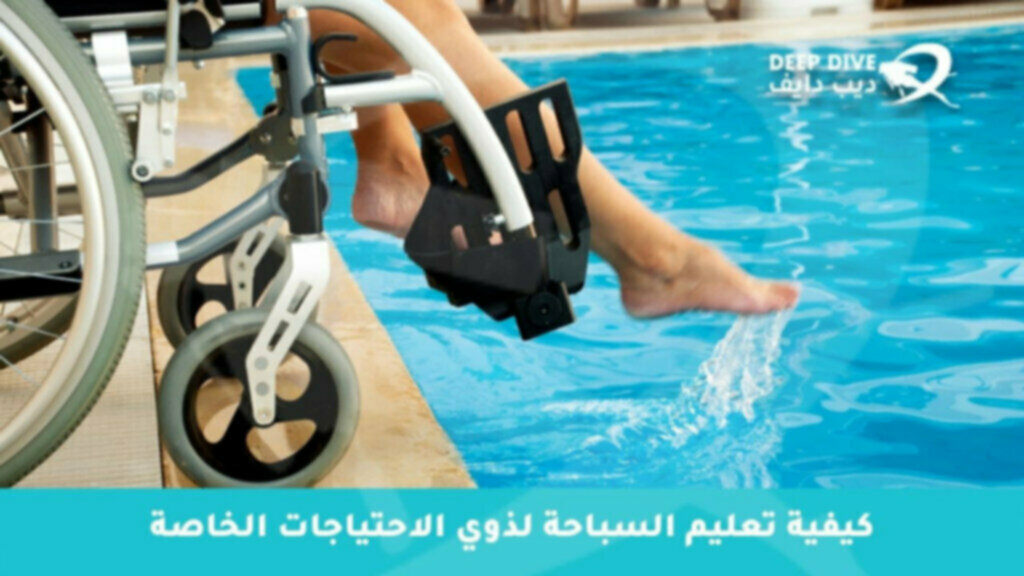
Learn about our freediving courses
Types of Swimming for People with Disabilities and Special Needs
We all know that self-confidence is essential to everyone’s well-being, and this is no different for children and adults with special needs.
Swimming helps people with disabilities regain body awareness and feel a sense of pride in their unique abilities. At our Deep Dive Center, we offer a variety of swimming programs, including several specialized swimming lessons for children and adults with disabilities, such as:
Swimming for People with Paralysis
People with paralysis begin their water exercises with the help of a specialist, and we find that in cases of complete paralysis—especially when stiffness is present—the paralyzed limb tends to float.
- In the early stages of paralysis, care must be taken with spinal injuries.
- The duration of aquatic rehabilitation for people with disabilities varies depending on the type of disability, the severity of the injury, and the person’s age
- Rehabilitation exercises for people with disabilities typically begin at age three and continue until around age seventy.

Backstroke for People with Disabilities
Breaststroke for people with disabilities is considered the best type of swimming, as it teaches the swimmer to float on their back in the water while keeping their arms in constant motion on either side of the body to maintain balance. The arms move alternately, moving away from and toward the body.
Breaststroke for people
with disabilities: Breaststroke for people with disabilities presents several technical challenges. In cases of thoracic spine injury accompanied by paralysis of the back extensor muscles and weakness of the pelvic and lower limb muscles, the swimmer swims in a tilted and difficult position; however, with repeated exercise of the back, shoulder, and back extensor muscles, gradual improvement occurs.
Learn first aid through safety and first aid classes

Swimming aids for people with special needs
Swimming is a valuable skill, and it offers people with special needs a way to experience the therapeutic benefits of hydrotherapy. There is a wide variety of swimming products designed for children and adults with special needs who have sensory processing disorders or developmental delays.development.
Swimming aids for people with disabilities; these items are specifically designed for swimming lessons for people with special needs
- Buoyancy belts
- Anchor Ropes
- and floating comfort mats,
- Chair
Swim diapers, and more for various age groups.
Frequently Asked Questions About Swimming Lessons for People with Special Needs
Is swimming at Deep Dive suitable for people with special needs?
u003cbru003eSwimming helps build core strength and improve balance and coordination. Being in the water can be calming for people with special needs. The buoyancy of the water reduces the pressure that gravity places on the muscles.
Do you offer educational support for children with special needs at Deep Dive?
u003cbru003eAlthough we do not provide direct financial assistance for swimming lessons for children with special needs, we partner with third-party organizations that may be able to help.
What are the benefits of swimming for people with special needs?
List of Swimmingu003cbru003eEquipment 1. Rubber prosthetic limbs for people with disabilities.u003cbru003e2. Floatationu003cbru003earms 3. Earplugsu003cbru003e4. Finsu003cbru003e5. Headphonesu003cbru003e6. Life jacket
Sources

